Skip to content

Cybercrime is constantly evolving, becoming more of a threat to businesses all around the world. From 2014 to 2018, the number of security breaches worldwide grew by 67% and the cost of cybercrime worldwide skyrocketed by 72%. Security experts also estimate that only 10% of cybercrimes are actually reported, with the majority going unreported due to various reasons, including fear of reputational damage and embarrassment.
Unfortunately, it seems this trend is only going to continue in the future. Global cybercrime costs are projected to rise by 15% every year for the next five years, translating to an annual cost of $10.5 trillion by 2025, up from $3 trillion in 2015.
This is why businesses must constantly work to fortify their cyber defenses. One of the easiest ways to do this is by conducting employee security awareness training on a regular basis.
Cybercriminals Target the Human Element
People are often considered the “weakest link†in cybersecurity. It comes as no surprise that cybercriminals today try to breach IT security by targeting the human element rather than taking a more technical approach.
Tessian’s 2020 Psychology of Human Error study reported that 88% of data breaches were caused by human error. Verizon’s 2022 Data Breach Investigations Report also found that 82% of breaches involved the human element, which includes employees using weak passwords, falling for phishing scams, and visiting dangerous websites. If these statistics are to tell us anything, it’s that strengthening the human element in cybersecurity is key to preventing most data breaches and securing your business.
With proper security awareness training, employees are more likely to practice good cyber hygiene and follow the company’s IT security policies, guidelines, and procedures.
They will also be better equipped to spot cyber threats, making them less likely to fall for the common tricks cybercriminals use. In the event the business suffers a cyberattack, employees would know how to respond properly; instead of being the “weakest link,†your employees become your company’s strongest line of defense.

The graph shows the decrease in phish-prone percentage1 after 12 months of utilizing security awareness training. This directly translates to your team being able to identify a malicious email and knowing better than to click on it.
1Phish-Prone Percentage is calculated based on the number of total failures (clicks, attachment opens, data entry, enabling macros on attachments, replying) divided by the total number of emails delivered in that campaign.
Technical Security Measures Are Effective When Combined With Human Know-How
Technological security solutions, such as virtual private networks (VPNs) and firewalls, play a vital role in safeguarding businesses from cyberthreats. However, technical measures would not be effective if employees inadvertently compromise them. For example, employees may forget to use the company VPN while they’re connected to public Wi-Fi. They may also turn off firewalls or fail to keep their software up to date. However, if employees are properly trained in cybersecurity best practices, they are less likely to make these simple, but costly mistakes.
By combining human know-how with technical security measures, businesses can mitigate many of their IT security risks.
Security Awareness Training As A Quick Fix
Simply sending phishing scam warnings to employees isn’t enough to properly educate them on cybersecurity. Effective security awareness training includes tools and resources on cybersecurity best practices, regular lectures or educational videos, and periodic cyberattack simulations. Doing all of these activities requires a lot of thought and potentially some organizational change to successfully implement. Fortunately, there are third-party providers that can do most of the leg work for you so all you have to worry about is getting the rest of your organization on board.
Charles IT, in particular, offers a security awareness training service that includes educational videos, email, USB, and phone phishing simulation tests, and the development of security incident reporting protocols. Rolling out the service is easy so you can quickly get started with your company’s security awareness training.
Cost Of Security Awareness Training
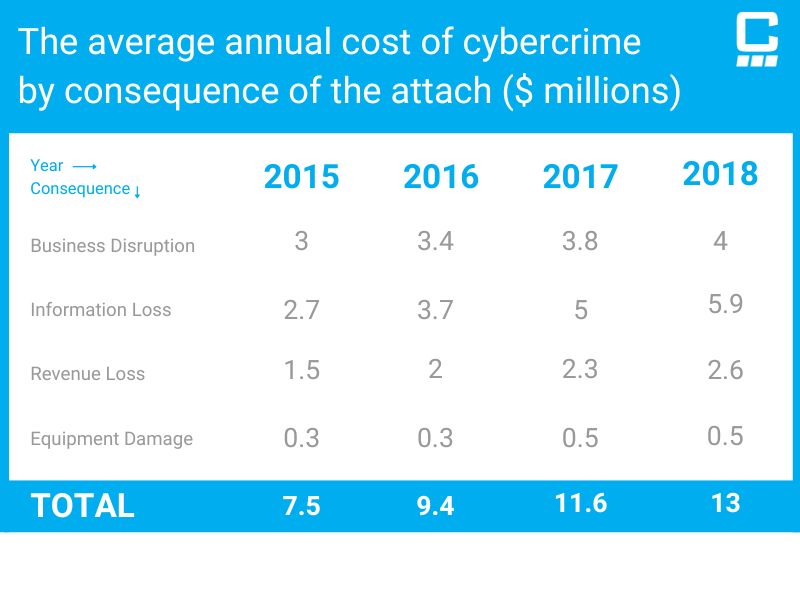
Accenture’s 9th Annual Cost of Cybercrime Study categorized cybercrime costs into four major consequences: business disruption, information loss, revenue loss, and equipment damage.
As the table below shows, the average total annual costs, by a consequence of cybercrime, have increased over the years.
The financial losses further skyrocket if the cyberattack results in a data breach. On top of the direct costs of the data breach, penalties may also arise due to non-compliance with relevant security and privacy regulations. Some fines can reach millions of dollars if it’s proven that the company failed to take appropriate measures to protect their customers’ data. For example, Equifax was required to pay a minimum of $575 million for their 2017 breach.
Reputational damage is also one of the most expensive consequences of a data breach. If your customers no longer trust you with their data, they may likely take their business elsewhere permanently.
In 2021, the total average data breach cost was $4.35 million globally, while the cost was more than double in the United States at $9.44 million. So if security awareness training can prevent even just one data breach every year, you’ll easily get a return on your investment.
Some security awareness training providers charge based on the number of employees. If you have 50 employees and training rates cost $20 per employee, then training will only set you back by $1,000. Compared to the cost of a cyberattack and data breach, security awareness training is quite affordable.
Want to learn more about Charles IT’s Security Awareness Training? Talk to one of our experts today!